
Introduction
This article describes creating an ADRS ADaM dataset for
lymphoma studies based on the Lugano 2014
response criteria.
Lymphoma response assessment under Lugano 2014 is based on a combination of imaging-based evaluations:
- PET-CT based assessment, providing metabolic response evaluation using the 5-point Deauville scale.
- CT-based assessment, providing anatomic response evaluation of nodal and extranodal disease.
Depending on the study and the disease subtype, response evaluation may use PET-CT as the primary modality (for FDG-avid lymphomas) or CT alone (for non–FDG-avid lymphomas). Some studies collect both PET-CT and CT response components, and a combined overall response is derived.
Please check Lugano 2014 Classification for more details.
Note: In many Lugano 2014 studies, the overall timepoint response may be collected directly from the investigator or independent review committee. In such cases, the collected overall response should generally be used according to the study protocol and statistical analysis plan, and the derivation shown below may not be needed.
The derivation below is provided only as an example of how an integrated timepoint response could be derived when the combined overall response is not collected directly. It is not intended as general Lugano 2014 implementation guidance. Study-specific rules may vary and should be aligned with the protocol, SAP, CRF design, and data review conventions.
For extended guidance on common steps in ADRS creation
and additional response endpoints, refer to the examples in Creating ADRS (Including Non-standard
Endpoints).
Lugano 2014 Response Categories for Lymphoma
The Lugano 2014 response criteria define lymphoma response using PET-CT based metabolic assessment and CT-based anatomic assessment.
The following tables summarize the response categories used in this vignette for PET-CT and CT assessments. These summaries are intended to support the example derivations and should be aligned with the study protocol and statistical analysis plan.
PET-CT Based Response Categories
| Table 1: PET-CT Based Response Categories | |
| Lugano 2014 response categories used in this vignette | |
| PET-CT Response | Description |
|---|---|
| CMR | Complete metabolic response |
| PMR | Partial metabolic response |
| NMR or SMD | No metabolic response or stable metabolic disease |
| PMD | Progressive metabolic disease |
| NE | Not evaluable |
| ND | Not done or not determined |
| NED | No evidence of FDG-avid disease, generally BICR or IRC only |
| PSP | Pseudoprogression |
CT-Based Response Categories
| Table 2: CT-Based Response Categories | |
| Anatomic response categories used in this vignette | |
| CT Response | Description |
|---|---|
| CAR | Complete anatomic response |
| PAR | Partial anatomic response |
| SAD | Stable anatomic disease |
| PAD | Progressive anatomic disease |
| NE | Not evaluable |
| ND | Not done or not determined |
| NED | No evidence of disease |
In this example data, NMR is used for no metabolic
response. Some implementations may use SMD for stable
metabolic disease. For the purpose of the combined overall response
derivation in this vignette, both NMR and SMD
map to SD.
Values such as NED, PSP, NE,
and ND require study-specific handling. For example,
NED by PET-CT is generally expected only from a blinded
independent central review (BICR) or independent review committee (IRC)
and may indicate that no FDG-avid disease was identified at baseline. In
that case, the integrated timepoint response often defaults to the CT
response if one is available.
Programming Workflow
- Read in Data
- Pre-processing of Input Records
- Derive PET-CT and CT Response Parameters
- Derive Combined Overall Timepoint Response
(
OVRLRESC) - Other Endpoints
Read in Data
To begin, all data frames needed for the creation of
ADRS should be read into the environment. This will be a
company-specific process. For this vignette, the main input datasets are
ADSL and RS.
For demonstration purposes, the SDTM and ADaM datasets based on CDISC Pilot test data from pharmaversesdtm and pharmaverseadam are used.
In this vignette, the RS SDTM dataset is expected to
contain lymphoma response assessments based on Lugano 2014 criteria. The
example RS dataset contains separate records for:
- PET-CT based response assessments, identified by
RSSCAT = "INCLUDING PET-CT SCAN". - CT-based response assessments, identified by
RSSCAT = "NOT INCLUDING PET SCAN".
# Lymphoma SDTM data
rs <- pharmaversesdtm::rs_onco_lymphoma

# Convert blanks to NA
rs <- convert_blanks_to_na(rs)

# ADaM data
adsl <- pharmaverseadam::adsl
Pre-processing of Input Records
At this step, it may be useful to join ADSL to your
RS domain. Only the ADSL variables used for
derivations are selected at this step.
adsl_vars <- exprs(TRTSDT)
adrs <- derive_vars_merged(
  rs,
  dataset_add = adsl,
  new_vars = adsl_vars,
  by_vars = get_admiral_option("subject_keys")
)
Partial Date Imputation and Deriving ADT,
ADTF, AVISIT, AVISITN etc.
If your data collection allows for partial dates, you could apply a
company-specific imputation rule at this stage when deriving
ADT. For this example, here we impute missing day to last
possible date.
adrs <- adrs %>%
  derive_vars_dtm(
    dtc = RSDTC,
    new_vars_prefix = "A",
    highest_imputation = "D",
    date_imputation = "last"
  ) %>%
  derive_vars_dtm_to_dt(exprs(ADTM)) %>%
  derive_vars_dy(
    reference_date = TRTSDT,
    source_vars = exprs(ADT)
  ) %>%
  mutate(
    AVISIT = VISIT,
    AVISITN = VISITNUM
  )
Derive PARAMCD, PARAM, PARAMN
In this RS dataset, both PET-CT and CT response records
use RSTESTCD = "OVRLRESP" and are distinguished by
RSSCAT and RSMETHOD. For this vignette,
RSTESTCD and RSSCAT are used to derive
PARAMCD, PARAM, and PARAMN.
# Prepare param_lookup for SDTM RSTESTCD and RSSCAT to add metadata
param_lookup <- tibble::tribble(
  ~RSTESTCD,  ~RSSCAT,                   ~PARAMCD, ~PARAM,            ~PARAMN,
  "OVRLRESP", "INCLUDING PET-CT SCAN",   "PETRSP", "PET-CT Response",       1,
  "OVRLRESP", "NOT INCLUDING PET SCAN",  "CTRSP",  "CT Response",           2
)

adrs <- adrs %>%
  derive_vars_merged_lookup(
    dataset_add = param_lookup,
    by_vars = exprs(RSTESTCD, RSSCAT)
  ) %>%
  mutate(
    PARCAT1 = RSCAT,
    AVALC = case_when(
      RSSTAT == "NOT DONE" ~ "ND",
      TRUE ~ RSSTRESC
    )
  )
Derive Combined Overall Timepoint Response(OVRLRESC)
Parameter
For this vignette, the combined overall timepoint response parameter,
OVRLRESC, is derived from the PET-CT and CT response
records collected at each visit.
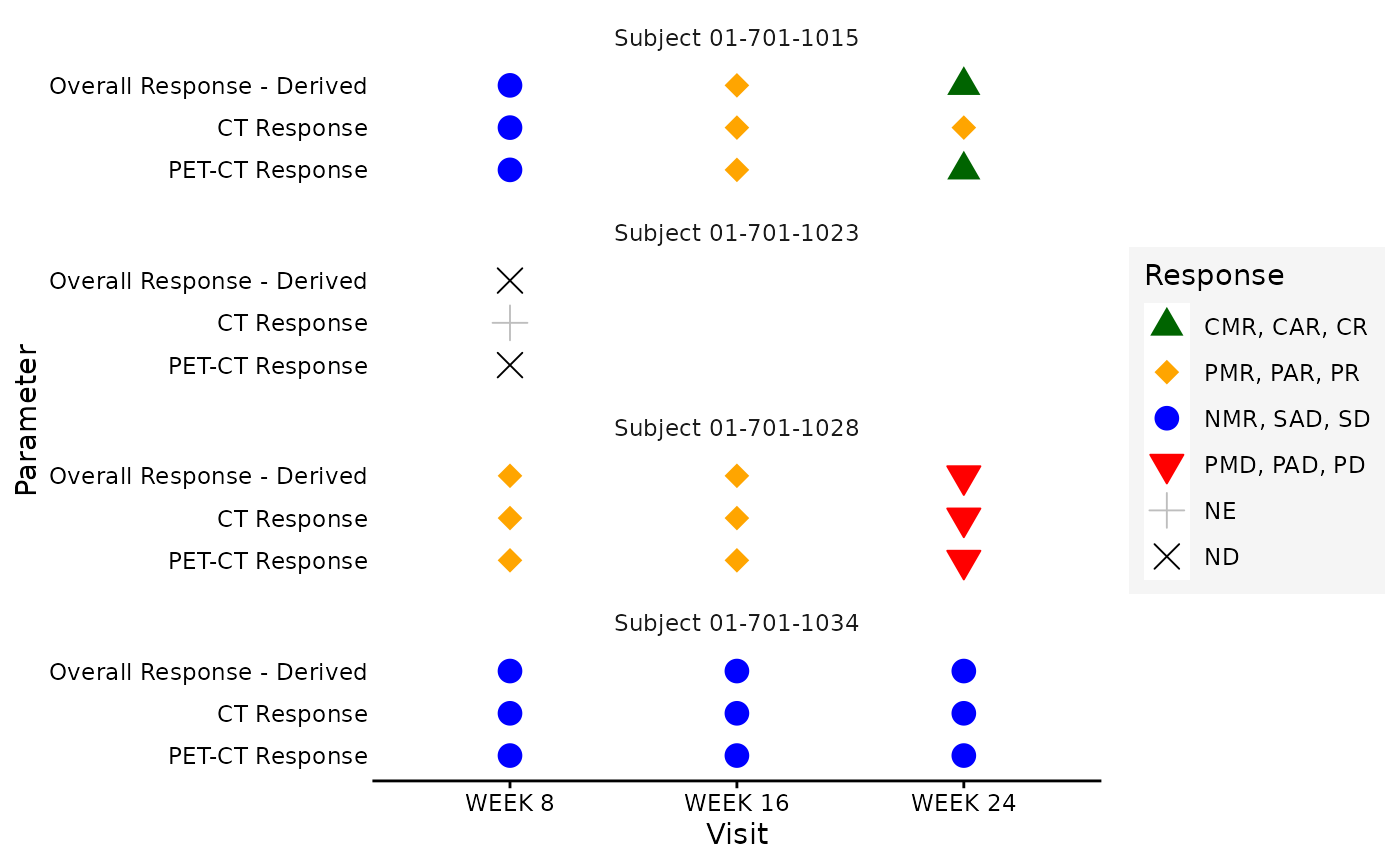
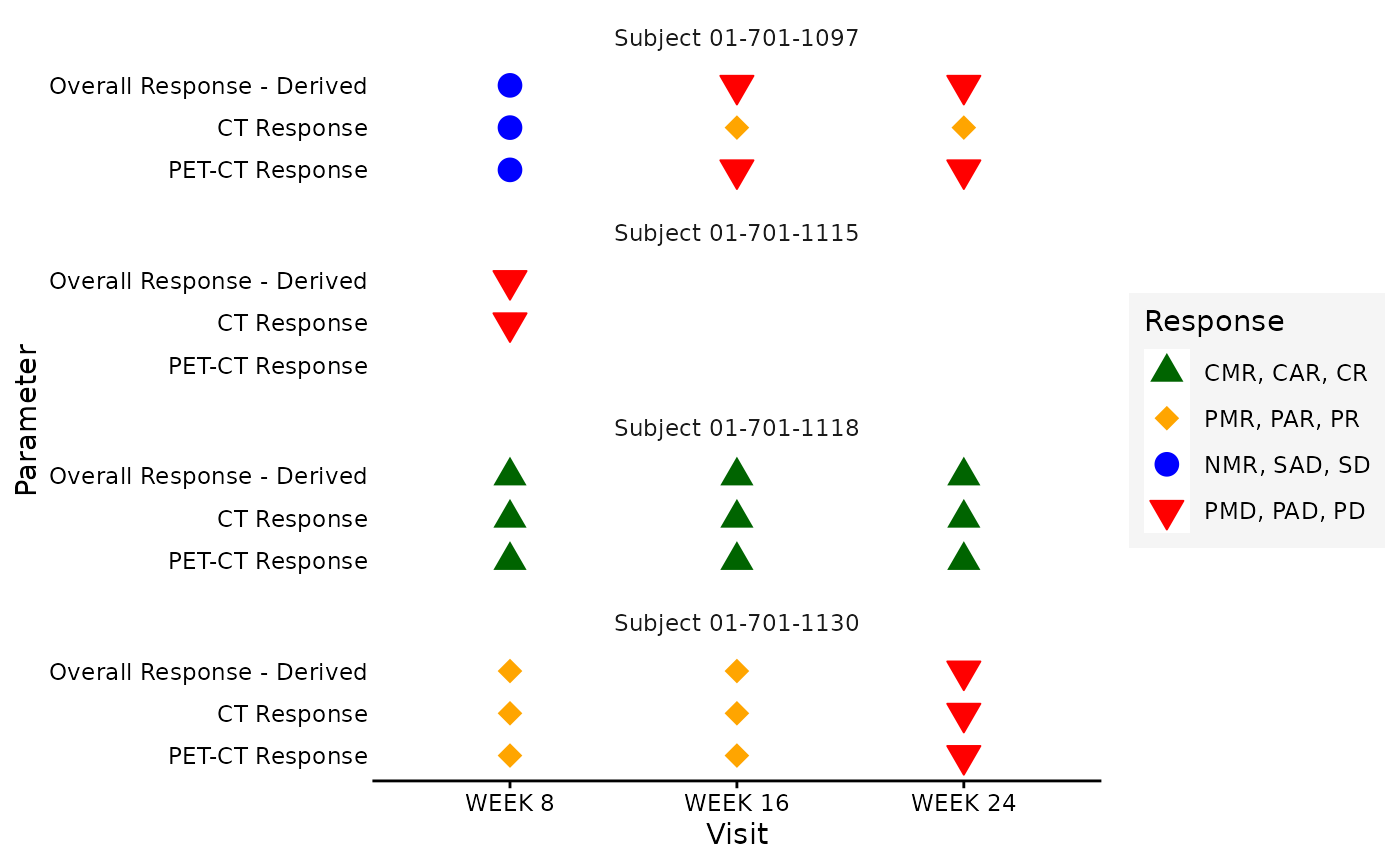
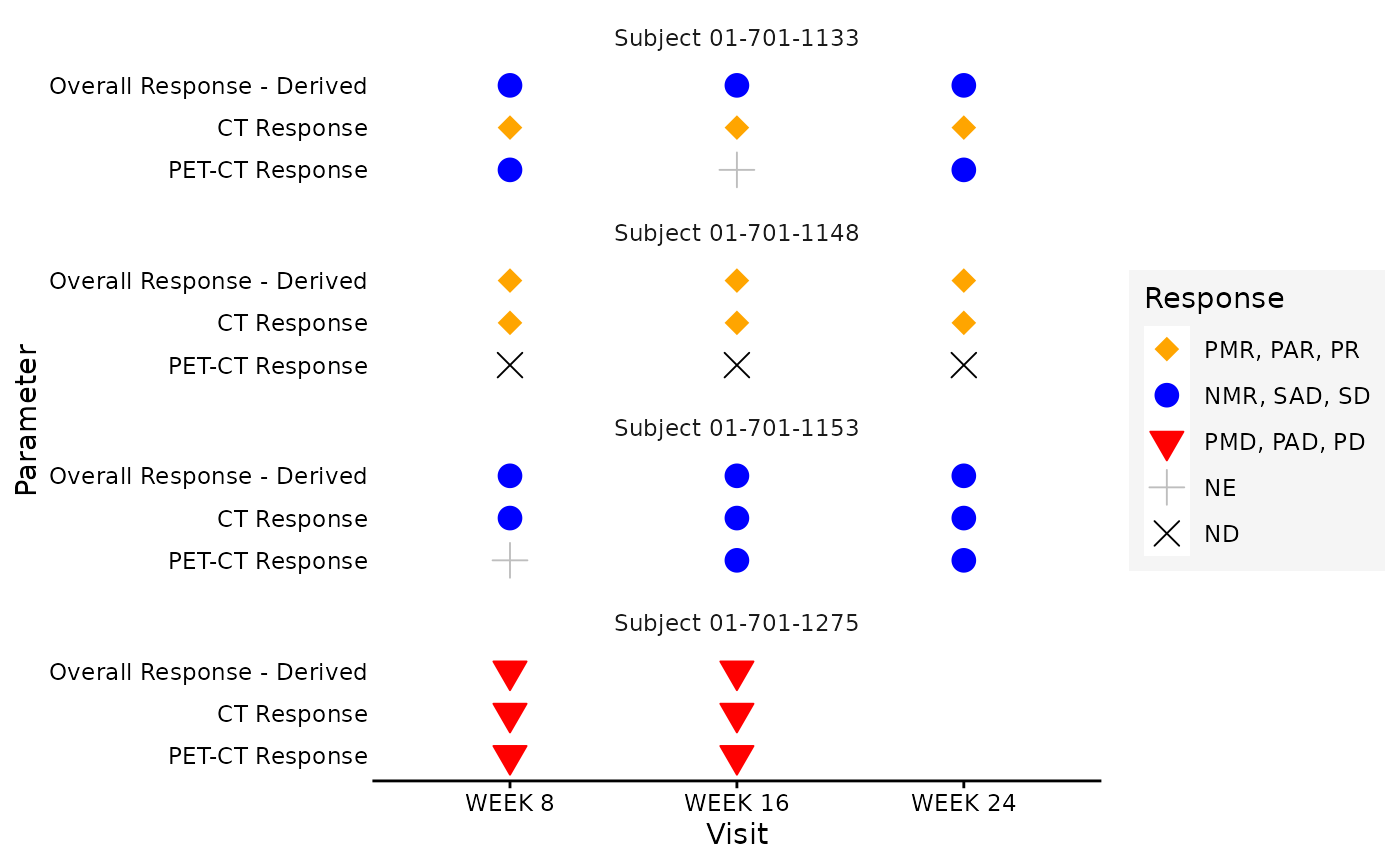
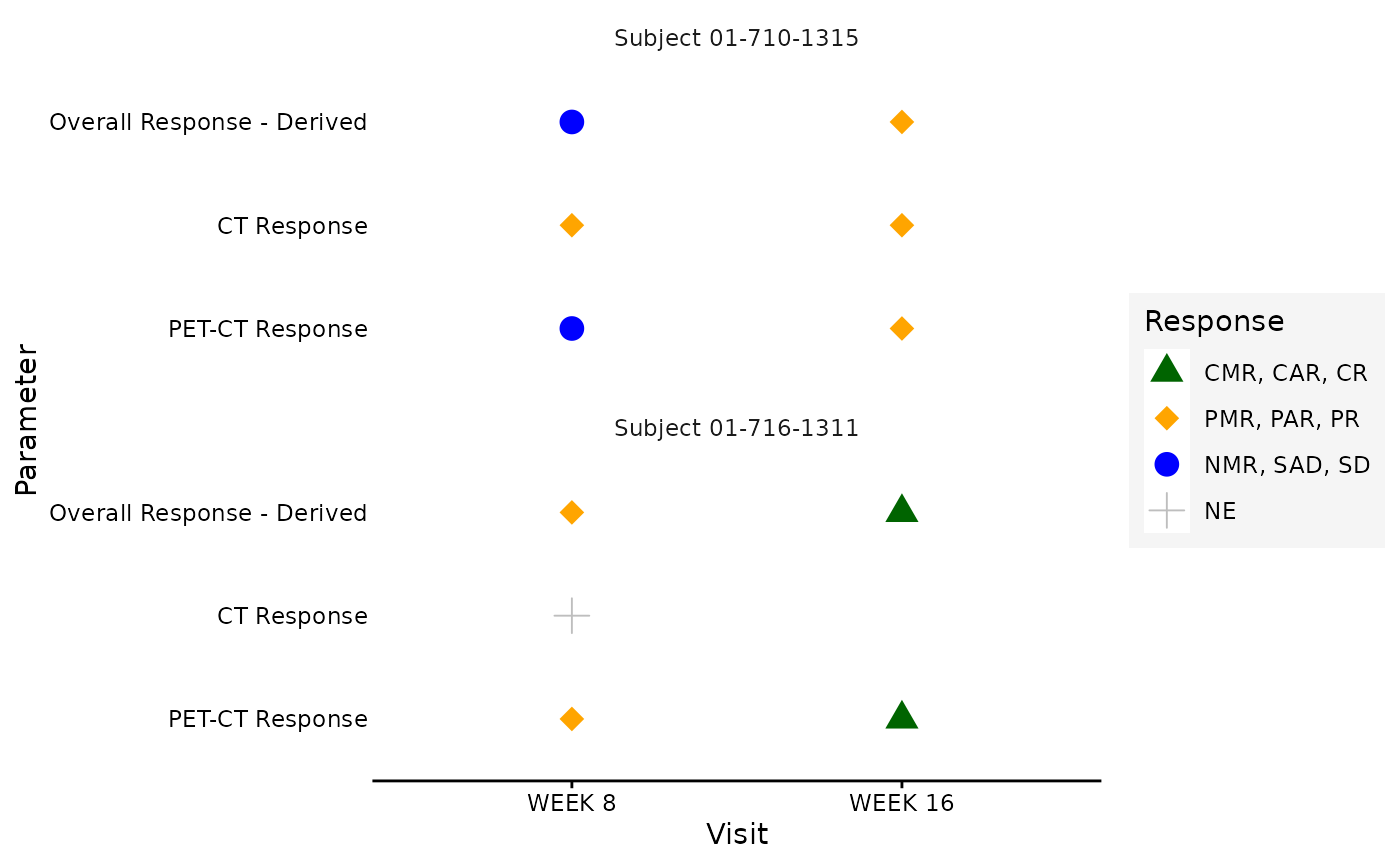
This example represents a scenario where the combined overall response is not collected directly on the CRF. Instead, it is derived using the available PET-CT and CT response records.
General Derivation Assumptions Used in This Vignette
The following table summarizes the assumptions used in this vignette to derive the combined overall timepoint response from PET-CT and CT response records under Lugano 2014. These assumptions are intended for demonstration purposes. Please refer to your study protocol, statistical analysis plan, and other study documentation before using in production analyses.
Table: Combined Overall Timepoint Response Based on Lugano 2014 Response Categories
| Table 3: Combined Overall Timepoint Response | ||
| PET-CT, CT, and Combined Overall Response Mapping | ||
| PET-CT Response | CT Response | Combined Overall Response |
|---|---|---|
| CMR | Any | CR |
| PMR | Any | PR |
| NMR or SMD | Any | SD |
| PMD | Any | PD |
| PSP | Any | PSP |
| NED | Any | Use current CT response |
| NE / ND, with prior evaluable PET-CT | CAR / PAR / SAD / NE / ND / NED | Carry forward prior PET-CT response |
| NE / ND, with prior evaluable PET-CT | PAD | PD |
| NE / ND, no prior evaluable PET-CT | CAR / PAR / SAD / PAD / NED | Use current CT response |
| NE / ND, no prior evaluable PET-CT | NE / ND / Missing | NE or ND |
| Missing | Any | Use current CT response |
| Missing | Missing | ND |
| This table is example-only and should be aligned with the study protocol and statistical analysis plan. | ||
| For evaluable PET-CT responses CMR, PMR, NMR or SMD, and PMD, the PET-CT response determines the integrated response in this example. | ||
| When PET-CT is NE or ND and the current CT response is not progressive, prior evaluable PET-CT response may be carried forward. | ||
| When PET-CT is reported as NED, the integrated response generally defaults to the CT response if available. If both PET-CT and CT are NED, the integrated response is NED. | ||
| Pseudoprogression handling is study-specific and is not implemented further in this example. | ||
Combined Overall Timepoint Response(OVRLRESC) Records
referenced from above table
# Pre-processing for Overall values
map_pet_to_overall <- function(x) {
  recode_values(
    x,
    "CMR" ~ "CR",
    "PMR" ~ "PR",
    c("NMR", "SMD") ~ "SD",
    "PMD" ~ "PD",
    "NED" ~ "NED"
  )
}

map_ct_to_overall <- function(x) {
  recode_values(
    x,
    "CAR" ~ "CR",
    "PAR" ~ "PR",
    "SAD" ~ "SD",
    "PAD" ~ "PD",
    "NED" ~ "NED",
    "NE" ~ "NE",
    "ND" ~ "ND"
  )
}
Derive prior evaluable PET-CT response for carry-forward logic
adrs <- adrs %>%
  restrict_derivation(
    filter = PARAMCD == "PETRSP",
    derivation = derive_vars_joined,
    args = params(
      dataset_add = adrs,
      filter_add = PARAMCD == "PETRSP" &
        AVALC %in% c("CMR", "PMR", "NMR", "SMD", "PMD"),
      by_vars = get_admiral_option("subject_keys"),
      order = exprs(ADT, AVISITN),
      mode = "last",
      join_type = "before",
      filter_join = ADT.join < ADT,
      new_vars = exprs(
        AVALC_P = AVALC,
        ADT_P = ADT
      )
    )
  )
Derive Combined Overall Timepoint Response
Please note that the by variables used below depend on the data
collection. In the example it is assumed that PET-CT and CT response
records are collected at the same day. If this is not the case, the
variables ADT, ADY, ADTM, and
ADTF shouldn’t be used. In addition, you may use
RSSPID to identify the records that should be combined.
adrs <- derive_param_computed(
  dataset = adrs,
  by_vars = exprs(
    !!!get_admiral_option("subject_keys"), !!!adsl_vars, DOMAIN, ADT, ADY, ADTM,
    ADTF, VISIT, VISITNUM, AVISIT, AVISITN
  ),
  parameters = c("PETRSP", "CTRSP"),
  set_values_to = exprs(
    AVALC = case_when(
      # PET-CT evaluable: metabolic response determines overall response
      AVALC.PETRSP %in% c("CMR", "PMR", "NMR", "SMD", "PMD") ~
        map_pet_to_overall(AVALC.PETRSP),

      # PET-CT NED: default to CT if CT is available
      AVALC.PETRSP == "NED" &
        AVALC.CTRSP %in% c("CAR", "PAR", "SAD", "PAD", "NE", "ND", "NED") ~
        map_ct_to_overall(AVALC.CTRSP),

      # PET-CT NED and CT missing: keep NED
      AVALC.PETRSP == "NED" & is.na(AVALC.CTRSP) ~
        "NED",

      # PET-CT is NE or ND and CT indicates progression
      AVALC.PETRSP %in% c("NE", "ND") & AVALC.CTRSP == "PAD" ~
        "PD",

      # PET-CT is NE or ND and prior evaluable PET-CT exists
      AVALC.PETRSP %in% c("NE", "ND") &
        !is.na(AVALC_P.PETRSP) &
        AVALC.CTRSP %in% c("CAR", "PAR", "SAD", "NE", "ND", "NED") ~
        map_pet_to_overall(AVALC_P.PETRSP),

      # PET-CT is NE or ND and no prior evaluable PET-CT exists
      AVALC.PETRSP %in% c("NE", "ND") &
        is.na(AVALC_P.PETRSP) &
        AVALC.CTRSP %in% c("CAR", "PAR", "SAD", "PAD", "NED") ~
        map_ct_to_overall(AVALC.CTRSP),

      # PET-CT is NE and CT is also NE or ND or missing
      AVALC.PETRSP == "NE" &
        (AVALC.CTRSP %in% c("NE", "ND") | is.na(AVALC.CTRSP)) ~
        "NE",

      # PET-CT is ND and CT is also NE or ND or missing
      AVALC.PETRSP == "ND" &
        (AVALC.CTRSP %in% c("NE", "ND") | is.na(AVALC.CTRSP)) ~
        "ND",

      # PET-CT missing; use CT response if available
      is.na(AVALC.PETRSP) &
        AVALC.CTRSP %in% c("CAR", "PAR", "SAD", "PAD", "NED", "NE", "ND") ~
        map_ct_to_overall(AVALC.CTRSP),

      # No valid response available
      TRUE ~ "ND"
    ),
    PARAMCD = "OVRLRESC",
    PARAM = "Overall Response - Derived",
    PARAMN = 3,
    PARCAT1 = "LUGANO 2014"
  ),
  keep_nas = TRUE
)
Other Endpoints
The OVRLRESC parameter can be used as input for the
derivation of standard endpoints, such as Best Overall Response (BOR),
Confirmed Best Overall Response (CBOR), and other oncology response
endpoints. Please see Creating ADRS (Including
Non-standard Endpoints) for guidance on how to derive them.